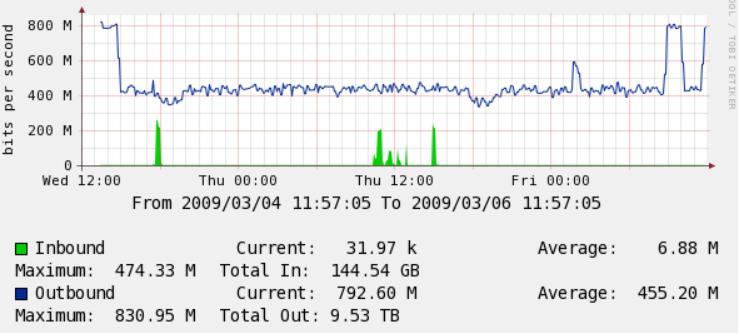
Cacti is a great graphing tool for monitoring your network traffic, and especially for capacity planning. However what if the links you utilise are greater than 100mbit? Cacti by default will only graph up to 120mbits with the graphs since they are only 32bit graph counters. In order to graph more than 120mbits of bandwidth 64bit counters are required. I have included as part of this post a XML import file for cacti which allows you to use 64bit counters but with Total Bandwidth as well recorded from the graphs. Thanks to a friend of mine (Mr DS) for finding this on the cacti forums. (http://forums.cacti.net/about4160-0-asc-0.html)
Well, ever since I started this site, Ive noticed that my DSL2 connection has not been that flash, and Ive been experiencing speed/dropout issues. The way I noticed this was that the Cisco 877 was not able to remain synced for more than 1-2 days without dropouts. Upon further investigation I discovered that the modem was receiving a large amount of HEC/CRC errors, around 2000+ each day. However the line seemed to work fine on a Billion 7300, with a Standard profile set on the DSLAM end, but this was still reporting a very high amount of errors. Also the SNR margin was not consistent and would fluctuate wildly from 10dB right down to -2dB. It was worse during nights etc.
So now im expecting anyday now for the Telco to come and fix this issue, as it appears its being caused from one of the poles in the street.
So what is this “Foreign Battery” issue? Well I managed find a few answers..
“Foreign battery will affect your ADSL sync. From my understanding foreign battery is unwanted voltage getting onto the line from somewhere. Which means the there is more voltage on the line than is normal, which in turn will give noise and interference on the line and cause issues with devices.”
“The high frequency of ADSL will often get through a poor or open circuit joint but low voltage VF (voice) signals will not. ADSL will work over most types of faulty lines surprisingly well, except for a Foreign Battery fault where your line is crossed with the battery side of another line, quite low voltages will kill ADSL but may not even be noticed on the phone.”
So if you are having these types of issues yourself, it could be a “Foreign Battery” fault!
I decided to downgrade to IOS c870-advsecurityk9-mz.124-15.T6.bin so I could try ADSL firmware AMR-3.0.043.bin, ver 20/22 of this IOS doesnt work with this firmware.
So far ive noticed 3.0.043 has slightly less Reed Solomon/CRC/Header errors, and notice improved performance. On previous firmware I noticed on upstream, I would get quite a few errors upon sync however with this firmware it seems fine and shows 0.
As we can see basically we are opening external ports on the router, and allowing that port to be routed back to our internal network on the specified IP address. (Remember to substitute your internal IP address above and the port you wish to use. You may also need to change the Dialer, either Dialer1 or Dialer0 depending how your device is configured)
Re-Direct Forwarding
In your internal network you may have 3 machines which all run RDP on port 3389. Now you cannot map 3389 three times, only 1 port can be used at a time.
So what you can do, is setup a redirection so that the external port numbers are different but map to the same 3389 port numbers internally.
Another example opening another external port to redirect to a different host inside the internal network for RDP
Another good example is you might be running a SSH server on your inside network on port 22, while externally you can configure it to be seen as port 6211.
This is a good security practice, so that you do not get constantly probed by bots on port 22 to try hack into your box with username/password combinations.
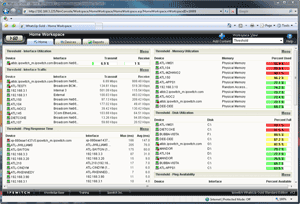
I started to learn a bit more about network monitoring tools and how to monitor the network. One of these tools is “Whats UpGold”, which can monitor uptime on devices, probe for interface bandwidth utilization and various other items. I have just begun using this software to monitor 300+ cisco devices for uptime, bandwidth utilisation, and recommend it highly. One thing about it I like, you can setup maps of a town/city/state with dot points and if a device goes down the dot shows red, and if its up its green, so you exactly know when/where it goes down.
Ipswitch WhatsUp Gold is the world’s leading network management software with over 70,000 networks reliably managed worldwide. Built on a scalable and extensible architecture offering automated device discovery and network mapping, real-time SNMP and WMI monitoring, and versatile alerting, notification, and reporting functionality, WhatsUp Gold delivers 360° visibility, actionable intelligence, and complete control.
Now if you have the $$$ this other superb tool offers far more in-depth monitoring called CA eHealth, it has a deeper inspection inside the network such as utilization, latency, uptime between interfaces, and capacity planning, and other very detailed reports, compared to WhatsUp Gold.
Apparently this tool for enterprises costs around $500,000AUD to have it setup, which is why this is only used by the best of the best network operation centres to monitor large and complex networks.
Help ensure the network performance and availability of LANs, WANs, routers, switches and the technologies and the network services provided over them. CA eHealth® Network Performance Manager provides comprehensive, vendor-independent technology that enables you to pinpoint areas of network performance degradation and generate real-time management reports to identify the causes of problems.
Now you are probably wondering what about some FREE monitoring tools?! I personally use CACTI which is a fantastic monitoring tool for my home network, but can be used for business/large enterprise also. The tool is open source, and has a great support forum which is excellent. The tool is a network graphing solution and many examples can be found on its website what can be monitored.
Using Cacti to monitor WAN traffic on DDWRT firmware routers
Cacti is a complete network graphing solution designed to harness the power of RRDTool‘s data storage and graphing functionality. Cacti provides a fast poller, advanced graph templating, multiple data acquisition methods, and user management features out of the box. All of this is wrapped in an intuitive, easy to use interface that makes sense for LAN-sized installations up to complex networks with hundreds of devices.